Reimagining AI: METAs Large Concept Models (LCMs) vs Large Language Models (LLMs)
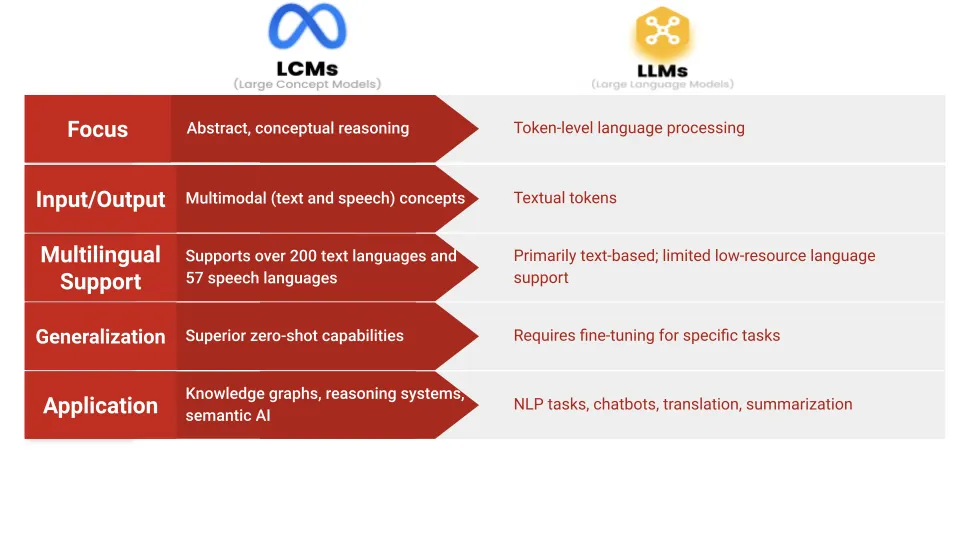
LCMs operate on higher-level semantic representations termed “concepts.” These concepts transcend language and modality, encapsulating abstract ideas. In the current implementation, a concept corresponds to a sentence, processed using the SONAR embedding system, which supports over 200 text languages and 57 speech languages.
Key Innovations in LCMs
- Conceptual Reasoning: LCMs enable reasoning at an abstract level, moving beyond token-level predictions to simulate human-like thinking.
- Language and Modality Independence: By leveraging SONAR embeddings, LCMs ensure seamless multilingual and multimodal integration.
- Hierarchical Processing: They adopt a top-down approach for handling complex tasks, improving coherence and abstraction.
LCMs are designed as sequence-to-sequence models in concept space, trained to perform auto-regressive sentence prediction. Key approaches include:
- MSE Regression: A foundational approach for sentence prediction.
- Diffusion-Based Generation: Variants such as the Two-Tower Diffusion LCM explore generative capabilities.
- Quantized SONAR Models: An upcoming enhancement in the LCM ecosystem.
LCMs transform input text into conceptual embeddings via the SONAR encoder, progressing through segmentation, encoding, reasoning, and decoding stages. These embeddings facilitate zero-shot generalization across languages and modalities, enabling LCMs to adapt with minimal fine-tuning.
Large Language Models (LLMs): The Current Cornerstone of AI
LLMs, such as GPT and BERT, have revolutionized natural language processing (NLP) by operating at the token level. Trained on massive datasets, they excel in generating human-like text and performing a wide range of NLP tasks.
Strengths of LLMs
- Textual Understanding: Exceptional proficiency in tasks like summarization, translation, and conversational AI.
- Scalability: With billions of parameters, LLMs capture intricate language patterns.
- Extensive Applications: Widely used in chatbots, virtual assistants, and content creation.
However, LLMs often face limitations in reasoning and abstraction, as their predictions are bound to token-level processing.
Applications in Agent AI
LCMs in Agent AI
- Semantic Understanding: Enables agents to grasp abstract ideas, improving decision-making and reasoning.
- Multimodal Communication: Facilitates seamless interaction across languages and modalities.
- Enhanced Planning: By reasoning at a conceptual level, LCMs aid in long-term strategic planning.
LLMs in Agent AI
- Conversational Interfaces: Powers chatbots and virtual assistants.
- Content Generation: Assists in creating coherent and contextually relevant responses.
- Task Automation: Handles routine tasks like scheduling and information retrieval.
Future Trends in Agent AI
- Hybrid Models: Combining LCMs and LLMs to leverage the strengths of both architectures.
- Improved Multimodal Integration: Enhancing LCMs to seamlessly process and reason across diverse data types.
- Ethical AI Development: Addressing biases and ensuring inclusivity in both LCMs and LLMs.
- Agent Personalization: Tailoring AI agents to individual user needs by integrating conceptual reasoning with linguistic fluency.
Meta’s Large Concept Models represent a significant leap in AI by introducing conceptual reasoning and multimodal capabilities. While Large Language Models remain indispensable for NLP tasks, LCMs open new frontiers in abstract and semantic understanding. Together, these architectures hold the potential to redefine the landscape of Agent AI, driving innovation in applications ranging from virtual assistants to autonomous decision-making systems. The future lies in synergizing their strengths to create intelligent, adaptable, and human-like AI agents.
Talk to our Career Advisor
Speak with our career advisor to get clear direction, understand the right opportunities, and take the next step in your career with confidence.
Get Your Course Brochure Now
Fill in your details and receive complete course information instantly.
- Detailed course syllabus & modules
- Duration, fees & learning format
- Certification & career opportunities
- Placement support & real-world projects
- Demo class & expert guidance info
Copyright © 2026, Edvora. All Rights Reserved.